
My schedule is pretty full at the moment so I'm not spending as much time at the wheel as I would prefer. But I take advantage of the time I have and I'm working on larger art pieces instead of the functional ware I normally focus on. So, in a way, I'm back in training, pottery-wise, since I haven't worked with larger pieces in some time and I don't get to practice as much as I used to. So each session is almost myself teaching myself, using the same lessons I would normally give a student. Recently, I found myself obsessing over every piece of advice I ever gave to nervous students while about five pounds of clay swirled around my hand and, in the process, I caught myself staring at my outside hand as my inside hand pushed out the clay. My focus should have been on the inside hand as it created the space. So I closed my eyes and started to work by pushing and feeling with the hand I couldn't see.
This can confuse a new student fairly quickly so I usually try to cover it early on. The inside hand pushes and shapes. The outside hand supports and guides. A beginner's instinct is to watch the outside hand and try to do too much with what you can see rather than focusing on the inside hand that actually needs to do the work.
I usually tell the nervous student, "It's not the outside of the pot that makes the pot. It's the emptiness inside the pot that makes the pot". Which is a straight up Taoist concept. The outer shape is a reflection of the space within. The focus should be on creating the inner space.
This has provoked more than a few blank stares which leaves an opening to elaborate and carry the lesson forward. But I've always been fascinated by the fact that some get hung up on the idea of emptiness being the focus. I think it's largely due to the Western notion that emptiness is bad. You wouldn't want something that's empty. Full is better. Empty is depressing. One shouldn't want an empty cup. Or stomach. Or house. Full means abundance and a lack of want or need while emptiness is the epitome of want and need.
But another way to look at it is that emptiness is potential. Stuff can happen, things can change, there is room to grow in the space that emptiness provides. An empty stomach can be a depressing thing but it also has the potential to be filled with an excellent meal. It's an extension of "the glass is half full/half empty" meme that is bit more philosophically flexible and a little less absolute.
Another interesting relevant Taoist concept is the Void. Now, from what I understand, the term "Void" is a poor translation of the actual concept but it's the closest that linguists can get to a very complex construct of the "resting potential" that the universe emerges from. Pretty heady stuff but another neat way to think of emptiness: Resting potential. Ready to change, waiting to be filled and utilized.
The pot is formed by creating the potential that is the emptiness and that potential is reflected in its exterior shape.
So the clay was spinning and the shape was forming as I discovered the emptiness and I found myself considering the fact that my outer reality is also a reflection of my inner potential just like the pot. And that begs the question: What is being reflected? Is it the true reflection of the potential or is it a reflection of the psychological clutter that anyone would gather over the course of a lifetime? That's a sticky one. Some would say that the clutter is manifestations of ego and all of it should discarded. I'm not so sure about that. Some of the clutter might have yielded a positive change and while the particulars should be abandoned maybe the change should be incorporated into the potential. Perhaps the change even made it's own space.
Still, an inner reality house cleaning may be in order. Go through the clutter and throw out the trash, organize what's left and, most importantly, rediscover the spaces within. Create the space to grow and change.
And to continue with the analogy, I think that meditation is the way to explore the house and yoga is a way to clear the clutter. Or at least begin to. As this practice develops, I'm noticing the created spaces but there are also a few boxes tucked in corners that I can't throw away yet. But I know they're there and I can get to them eventually. The point is I am finding space. I'm discovering potential.
But what is being reflect even as the clutter is being cleared and the spaces created? Is the true self even in there any more? Or is it all ego?
I think it's time to delve deeper into this ego thing and examine the relationship between labels and limitations.
But that's going to take some thought and I'm still making space.
Monday, August 12, 2013

Tuesday, August 06, 2013
Can't Beat Free
I am pretty steady on the diet these days but it's still challenging at times. I'm always on the hunt for new ideas and new ways to do the diet better but sifting through all the info out there is impossible. So I have to rely on the occasional article or a recommended recipe but even then it's hit and miss and what I really want is ideas that I can take and twist to my own designs.
I found this site which keeps track of the free books for the Kindle and, under the cooking category, I found quite a collection of books on paleo and cleaner living. Now, the diet is a modified paleo system which means that some of the better ideas come from paleo cookbooks. But full sized cookbooks are (pun alert) hard to digest and pulling the good stuff out is time consuming. The good thing about most of these little ebooks is that they are short, concise and to the point.
For instance, I found Simple Gluten Free & Paleo Bread: Fast, Sumptuous and Guilt-Free Baking Recipes and got it downloaded before they took it off the free list (it's still available for loan to Prime members. Note that the free books are apparently a promotional thing so they may not be free forever). Anyway I got it downloaded and gave it a read. Very concise. Very to the point. Still a lot of good info. The recipes are simple and the ingredients are not too outrageous although the first basic recipe uses 2 cups of blanched almond flour and that stuff is expensive
 But if you were looking for bread and wanted to stick to gluten-free, it looks like a great way to go. I'll have to wait for the next paycheck to try it out and report back though.
I would normally suggest avoiding any sort of bread-like food to avoid any psychological triggers but I've have a beef stew recipe that begs for bread and I've been craving beef stew.
The site has a quite a few books to peruse and it changes daily. Lots of smoothie and juice books, I noticed, and quite a few covering everything from desserts to slow cookers. There are other categories, as well. The cooking category was the one that caught my attention and filled up my Kindle first.
Here is the link again for convenience: http://centslessbooks.com/cooking-food-and-wine.html
.
I found this site which keeps track of the free books for the Kindle and, under the cooking category, I found quite a collection of books on paleo and cleaner living. Now, the diet is a modified paleo system which means that some of the better ideas come from paleo cookbooks. But full sized cookbooks are (pun alert) hard to digest and pulling the good stuff out is time consuming. The good thing about most of these little ebooks is that they are short, concise and to the point.
For instance, I found Simple Gluten Free & Paleo Bread: Fast, Sumptuous and Guilt-Free Baking Recipes
and got it downloaded before they took it off the free list (it's still available for loan to Prime members. Note that the free books are apparently a promotional thing so they may not be free forever). Anyway I got it downloaded and gave it a read. Very concise. Very to the point. Still a lot of good info. The recipes are simple and the ingredients are not too outrageous although the first basic recipe uses 2 cups of blanched almond flour and that stuff is expensive But if you were looking for bread and wanted to stick to gluten-free, it looks like a great way to go. I'll have to wait for the next paycheck to try it out and report back though.I would normally suggest avoiding any sort of bread-like food to avoid any psychological triggers but I've have a beef stew recipe that begs for bread and I've been craving beef stew.
The site has a quite a few books to peruse and it changes daily. Lots of smoothie and juice books, I noticed, and quite a few covering everything from desserts to slow cookers. There are other categories, as well. The cooking category was the one that caught my attention and filled up my Kindle first.
Here is the link again for convenience: http://centslessbooks.com/cooking-food-and-wine.html
.
Friday, August 02, 2013
Yoga and Pottery
The asanas of yoga are practiced with the intent of preparing for seated meditation so I shouldn't be surprised by the fact that a yoga practice would help with working on the wheel.
I haven't had much time to get my hands muddy since I started the immersion program. As a matter of fact, last Sunday was the first time I really had a chance to sit and work for any length of time. I think I've mentioned before that what I found inspiring about yoga was that it got me to that quiet place that I experience when working on the wheel for a while. What I noticed as I sat down and got to work was that I found that quiet space much faster than I ever had before. Just me, the clay and the hum of the wheel. I let the clay do what it wanted for the most part and was pretty satisfied with the outcome.
Now working on the wheel is not conducive to good posture. You can try to keep your back straight but you won't get far since you need to lean into the clay for leverage and your elbows need to be braced, sometimes on your knees, sometimes on your side so you spend some time hunched over. Getting up can be a painful exercise of unkinking the bowed spine as you rise up and stagger around for a minute clutching your lower back. Or at least that's how I used to get up after an hour or so on the wheel.
This time was different. I threw three mediums sized pieces. And then got up and took several steps to the drying rack before I stopped and wondered at the lack of pain and stiffness. There was none. Not even a twinge. After years of rising hunched and sore, I just stood up and walked like it was nothing.
I've always had back issues, including a herniated disc, and I can say definitively that yoga helps. As a matter of fact it helps a lot. We spend a lot of time in class stretching the spine and twisting and, at first blush, I expected there to be more pain. After years of problems I'm a bit paranoid about anything concerns the spine and maybe even a bit overprotective. But the stretching, the twisting, the opening of the vertebrae has alleviated almost all of my symptoms and, as my core gets stronger, my confidence goes up. I'm not going to push it too far and I still follow all the basic rules (lift with legs, don't twist and lift, etc.) but still it's amazing how fast a steady practice has helped a problem that has plagued me for years.
And getting up from the wheel pain-free is my own little personal victory against getting older. I can't do a headstand yet and I am far from a full lotus but I think I'll measure success by these small achievements and relish the fact that one of my favorite activities no longer punctuated by pain.
I haven't had much time to get my hands muddy since I started the immersion program. As a matter of fact, last Sunday was the first time I really had a chance to sit and work for any length of time. I think I've mentioned before that what I found inspiring about yoga was that it got me to that quiet place that I experience when working on the wheel for a while. What I noticed as I sat down and got to work was that I found that quiet space much faster than I ever had before. Just me, the clay and the hum of the wheel. I let the clay do what it wanted for the most part and was pretty satisfied with the outcome.
Now working on the wheel is not conducive to good posture. You can try to keep your back straight but you won't get far since you need to lean into the clay for leverage and your elbows need to be braced, sometimes on your knees, sometimes on your side so you spend some time hunched over. Getting up can be a painful exercise of unkinking the bowed spine as you rise up and stagger around for a minute clutching your lower back. Or at least that's how I used to get up after an hour or so on the wheel.
This time was different. I threw three mediums sized pieces. And then got up and took several steps to the drying rack before I stopped and wondered at the lack of pain and stiffness. There was none. Not even a twinge. After years of rising hunched and sore, I just stood up and walked like it was nothing.
I've always had back issues, including a herniated disc, and I can say definitively that yoga helps. As a matter of fact it helps a lot. We spend a lot of time in class stretching the spine and twisting and, at first blush, I expected there to be more pain. After years of problems I'm a bit paranoid about anything concerns the spine and maybe even a bit overprotective. But the stretching, the twisting, the opening of the vertebrae has alleviated almost all of my symptoms and, as my core gets stronger, my confidence goes up. I'm not going to push it too far and I still follow all the basic rules (lift with legs, don't twist and lift, etc.) but still it's amazing how fast a steady practice has helped a problem that has plagued me for years.
And getting up from the wheel pain-free is my own little personal victory against getting older. I can't do a headstand yet and I am far from a full lotus but I think I'll measure success by these small achievements and relish the fact that one of my favorite activities no longer punctuated by pain.
Friday, July 26, 2013
The Perfect Village
So what about the slow dissolution of the ego? Is it a good thing or not? Should we let it go and seek a unity of spirit with the cosmos or nurture it and define ourselves fully as a an entity in this reality?
That's probably the big question for anyone. And everyone may have a different answer. Did you come into this life to be something particular so you could explore a state of being? Or did you come in to learn how to let it all go and become consciously aware of this reality, one eternal moment at a time?
As usual, it could be a little of both. You came in with a plan to explore a state of being that would lead you to a greater awareness or even a singular awareness that the mystics speak of in revered tones.
Or you could just be along for the ride, ready to help others on their paths.
"The Perfect Village" is the thought experiment I use to discuss concepts of reincarnation with someone who may have trouble with the idea but is genuinely interested in talking about it. It goes like this:
Imagine a perfect village, nestled in a forest with a picturesque town square surrounded by ancient buildings. Everyone lives and no one dies and all is well. Existence is fairly stable. One might even say eternal. But one day, a group of youngsters realizes that there are various roads that lead out of town and this causes quite a stir. Why are the roads there? Where do these roads lead? Have they always been there? What are they for?
The old-timers sitting under awnings at the edge of the square just shrug and smile and offer no information. Undeterred, the youngsters gather in the park and make a plans. Each will choose a road and they will travel down a ways and then return and report back to the others about what they find. So each ventures out and after a time they begin to return. And each has a different story. Some marvel at the wonders they saw while others speak of horrors and pain. Some paths were very short. Other paths were long and winding, with multiple forks so that decisions had to be made. Some left things undone before they had to return. Some didn't return at all.
The stories are exchanged and new ventures are planned since one heard tales of a path that she now wants to see for herself. Another wants to go back and finish what was started. Others ask for help from friends because the path was hard and they need help to finish the experience. Some wanted to go and find those that didn't return. Each has learned and discovered and grown from the experience and there is so much to explore that the idea of not going only occurs to a scant few.
So new paths are chosen and the young ones strike out again. And again.
And the old ones sit in the shade, shake their heads and smile, remembering the days when they used to pick a path.
It's an interesting way to present a very ancient idea. (I also like The Egg by Andy Weir as an idea engine to get the mind to relax around the idea of infinity.) A lot of times it leads to a discussion about which path you would have chosen in that situation. Would you have selected a dangerous path, a safe path, a path rife with decisions points? Or would could you have possible just gone along to help?
Personally, I think that's where I noticed a crack in the hard edge of my ego. My path may not be my path. I might just be here to meet someone one at some time to say or do something that's almost scripted so that a set of experiences happen that was agreed upon. Is that possible? And then what is the ego except the part you play?
Think about that. The ego is just the part you play.
So what happens when you toss out the script and improvise? Is that bad? Wasn't the Universe expecting you to hold up your end of the script?
Not necessarily. I think that it's possible to ditch the script, become aware and walk the path consciously. The ego is gone and the way is suddenly clear. Forks in the road become conscious choices as opposed to blind decisions spurred by a function of the ego. Bumps and potholes suddenly become opportunities to learn and grow. The path becomes golden, your experience more real.
The ego just defines the part. And now I'm curious about the actor playing the part. Can I even say that I know him?
Which brings us back to the slow dissolution of the ego. A gentle perusal of what lies beneath the veneer of a carefully (or perhaps not so carefully) defined role. I am not proposing radical changes. I just want to test the edges and see if I can live a bit more consciously and a little less driven.
Although, that alone could lead to some very interesting forks in the path.
Wednesday, July 24, 2013
New Yoga Mat Review: myMAT by Manduka
I went with a cheap 3mm basic mat from the local big box to get started but quickly discovered that 3mm isn't enough for my trick knee at the moment. At the same time I didn't want something so think that it took away from the balancing postures. I am quickly learning that I need to feel the floor to balance and since balance is one of my challenges, I'm not going to put a 1/2 inch of foam between me and the floor.
The next size up at the local big box was a 5mm thick mat. The 3mm mat ran about ten dollars while the 5mm, sporting a whopping 2 more millimeters, was sixteen dollars and the same dimensions. From there, they went to 1/2 inch thick fitness mats that were actually shorter that the yoga mats for around twenty dollars.
So I was done with the big box.

I started looking online and almost immediately found 1/4 inch myMAT from Manduka and then spent some time staring at a ruler trying to decide if a 1/4 inch was too thick or too thin. But the price was right, the reviews were good and it was longer than the mat I had so I decided to take the chance.
So two days later (thank you, Amazon Prime), I had the mat and I got a first hand look at the thickness. Not too thick, not too thin. Probably just right. But it would take a couple of sessions at the studio to really test it.
A couple of the reviews on Amazon mentioned a chemical smell once you take it out of the package and I noticed it as well but after a wipe down with mild soap and water and the laying out for a day, the smell was gone. Even up close.
Now, I've had it for two classes, an energetic Beginner II class and a more rooted and pose heavy Intermediate/Advanced class. The new mat performed well in both. It stays where you put it and is just sticky enough to give you some footing without being so sticky you have to peel it off everytime you move. The 1/4 inch padding is just right between a hard surface and a sometimes tender knee without sacrificing the grounding effect of feeling the floor. I like the extra length (74 inches) although I could probably even use and extra inch or two but then I would be sucking up real estate in class so I think I can make do.
So for the money, it's a great mat for the level I'm at. I could spend a lot more money on a fancier mat (check the link to the store at the top of the page for some pricier selections) but I think this one could take me quite a ways into this new practice.
There are other colors available as well. Here's the link for shopping and parusal: 1/4 inch myMAT from Manduka
The next size up at the local big box was a 5mm thick mat. The 3mm mat ran about ten dollars while the 5mm, sporting a whopping 2 more millimeters, was sixteen dollars and the same dimensions. From there, they went to 1/2 inch thick fitness mats that were actually shorter that the yoga mats for around twenty dollars.
So I was done with the big box.

I started looking online and almost immediately found 1/4 inch myMAT from Manduka
and then spent some time staring at a ruler trying to decide if a 1/4 inch was too thick or too thin. But the price was right, the reviews were good and it was longer than the mat I had so I decided to take the chance.So two days later (thank you, Amazon Prime), I had the mat and I got a first hand look at the thickness. Not too thick, not too thin. Probably just right. But it would take a couple of sessions at the studio to really test it.
A couple of the reviews on Amazon mentioned a chemical smell once you take it out of the package and I noticed it as well but after a wipe down with mild soap and water and the laying out for a day, the smell was gone. Even up close.
Now, I've had it for two classes, an energetic Beginner II class and a more rooted and pose heavy Intermediate/Advanced class. The new mat performed well in both. It stays where you put it and is just sticky enough to give you some footing without being so sticky you have to peel it off everytime you move. The 1/4 inch padding is just right between a hard surface and a sometimes tender knee without sacrificing the grounding effect of feeling the floor. I like the extra length (74 inches) although I could probably even use and extra inch or two but then I would be sucking up real estate in class so I think I can make do.
So for the money, it's a great mat for the level I'm at. I could spend a lot more money on a fancier mat (check the link to the store at the top of the page for some pricier selections) but I think this one could take me quite a ways into this new practice.
There are other colors available as well. Here's the link for shopping and parusal: 1/4 inch myMAT from Manduka
Friday, July 19, 2013
Yoga, Heavy Metal and World Peace
I'm trying not to drown in the near infinite sea of information that is the Internet concerning all things yoga to the point that I've declared a moratorium on surfing the subject until I'm further along. There is so much information out there and some of it doesn't match up. So I will stick to the reading list and pay attention in class for now and focus. Teacher has mentioned once or twice how it's possible to be addicted to information which can rob you of the experience of the moment and I swear she's looking at me every time she brings it up.
But, still, I have found some things and made some observations. For instance, this site explains mudras which are various hand positions that provide a variety of effects. My understanding is that "mudra" basically means "energy seal". Very interesting stuff and it explains of a lot of the meditation poses one might see where the fingers are curled in various configurations while resting on the knees or lap.
One mudra in particular caught my eye which was the Apana Vayu Mudra which is the "Gesture of the Heart". According to this particular website, at least. And it just so happens to bear a remarkable resemblance to this pop-culture gesture.
Well, that's a bit of a coincidence. Could there possibly be a connection? Is the the ancient practice of yoga the original one way ticket to midnight? Could the most noble and righteous genre of rock music be the yang to yoga's yin, approaching the quiet mind and tranquility of the perfect moment from the direction of staccato solo and the grounding influence of a solid bass line backed up by a double drum kit? Is it possible to find the end of the ego in the cacophony of energetic sound or the symphonic chaos of a Metallica album? Could this be the end solution? The unifying theory of everything? Could an enlightened physicist look down at his hands, one folded in the Apana Vayu Mudra, the other hand slowly rising to salute those who are about to rock, and suddenly realize just how connected it all is? He could write the perfect equation that would bind the quiet to the riot and bring us limitless energy from power chord and wailing voice screaming incomprehensible lyrics.
Could the power of heavy metal yoga finally bring peace to the world?
Ok, probably not.
I consulted with Teacher and the version of the Apana Vayu Mudra she is familiar with is more like this. You touch your two middle fingertips to the tip of your thumb and then tuck the first finger to the base of the thumb. It still looks a little like the metal horns but not quite. I point again to how much information is out there and how much of it doesn't match up and I trust Teacher over the Internet.
However, I did some research and the wikipedia article on the origin of the horny gesture again is a lesson on the amazing fluidity of modern culture. For the lazy, Ronnie James Dio of Black Sabbath fame actually took the gesture from his Italian grandmother who used it as a ward against the evil eye but the subculture of metal took it and owned it as their salute. So when metal fans throw up the horns towards their favorite song or band, they are actually warding against the evil eye.
As I said, the fluidity of modern culture is amazing.
But this all did force me to reminisce and consider a few things. Back in the nineties, I worked as a roadie and ran lights for a local band which gave me the opportunity to surf the edge of the music scene and explore a wide range of venues and environments. And I found myself making certain assumptions. In a country bar, there is going to be a fight at some point. In a bar that plays classic rock, there is going to be a fight. At some point. Even in dance clubs, I saw a brawl or two (if a bunch of loose wristed, slap fighting counts as a brawl).
But in the metal bars, which I probably frequented more often, I don't really remember that many fights.
Now some would say that the mosh pit was it's own fight. For the uninitiated, the mosh pit is the area in front of the main stage where dancers (usually men) don't really dance as much as they bounce and slam into each other to the beat of the music. To the same uninitiated, it probably looks like a brawl but it's really not. I enjoyed a pit or two. Or three. And the dynamic was energetic but strangely safe. In my experience, if someone went down, those around him pulled back and picked him up. If someone was obviously in trouble, this strange, morphing group hug would happen so that the person would be transferred to the edge and deposited into the nearest chair to catch is breath. If someone was obviously trying to get truly violent, the same group hug thing would happen until they were ejected into the waiting arms of burly bouncers. In my experience, no one wanted to get anyone hurt (too badly, anyway) because it would stop the music.
Let's not sugar coat it though. There was anger. There was rage. You could feel it blazing off the mob like the heat from a wildfire and this should be expected when a bunch of twenty-somethings sweating testosterone get amped up on fairly angry sounding music and choose to express the pent up rage of the insecure youthful mind in the form of violent dancing. But that's just it. They were expressing their rage and anger in an appropriate venue. As strange as that may seem. One could even bear witness to the relaxed faces and easy smiles at the end of the night. The rage was expressed and it was gone. At least for a little while.
(Side Rant: Before any of you take what I'm saying and run out to schedule your six-year old's next birthday at the nearest metal venue because it's full of happy, shiny people, please be reminded that I'm using one aspect of my own experience to to illustrate a point. Metal, for the most part, is pretty dark and scary. That's why it's called metal. To be fair, a lot of bands and musicians have come out against the pits due to injuries or even deaths but I can only report on my experiences and note that my experiences occurred in smaller, more intimate venues instead of stadiums were mob mentality can easily overrule common sense. Also, I think modern metal is trying too hard to push on taboos and social boundaries in an attempt to stay relevant. The music seems to be getting lost in favor of stunts and stage gags. Old metal is the best metal and if you want to explore some of the history and variations, I present to you the Map of Metal. :End Side Rant)
So can metal, as dark and sinister as it is, teach us something about the emotional reality of the common human?
Little baby humans are trained early that some emotions are bad. The parents may not even realize that the training is happening. They just want to get control of the wailing two-year old throwing a tantrum in the middle of the grocery aisle. The child is expressing anger and the parents explain to the child that expressing that emotion in that venue is inappropriate. The child hears a bunch of big words but gets the gist that expressing anger is bad.
And so we grow into emotionally constipated adults, pushing down "inappropriate" emotions until they fester and ooze out through other avenues or, worse, we explode in a spectacular fashion and then feel guilty for the damage done.
I personally don't believe in "bad" emotions. Emotions are the security system of the spirit and the body. We make them into more than that through a bunch of intellectual voodoo but in the end it's just the way the body and spirit are kept safe.
Let's use our metal example: Anger is considered a negative emotion. Unchecked it makes people do remarkably stupid things. But what about anger expressed toward an injustice? What about the anger that often pushes people into action to make a situation better? Is that anger wrong?
What about fear? Fear makes us run away or fight. Fear is considered a negative emotion. But in a dangerous situation, fear can be your best friend as long as you don't fall into a fetal position and fail to act. Consider the fact that fear is there to give your body an adrenaline boost to help you through that dangerous situation. Fear is not negative. One's reaction to fear is what is negative. Also, admitting to one's fears and justifying them is a road to self-discovery. Honestly, the only time one should experience fear is when the physical body is in obvious trouble. If a person lives their life in fear then that person should ask some hard questions about the true sources of those fears.
What about jealousy? That's a tricky one. Jealousy usually stems from self-esteem issues or a lack of faith in a certain relationship. Of any "negative" emotion, jealousy is often the most revealing if one is honest with oneself as to why they are feeling jealous. Am I judging myself and coming up short? Am I judging the relationship and its not what I think? How honest can you be with yourself? Here, again, is another passport to self-discovery. If you can't be honest about the feelings that certain situation generates you will continue to have those feelings until they eat you alive. Process the feelings honestly and see what happens.
Let's even take on the biggie: Hate. It's wrong to hate. But once again what if the hate is justified? I can hate racism. I can hate bigotry. I can hate corporate welfare. Is that wrong? Hate is really just the child of fear and anger. What do I fear? What am I angry about?
And, for all of these, how do I express it? Or do I express it? Can I express it and then question it and try to answer to the true source of the emotion? As I see it, the problem with these "negative" emotions isn't so much their potential negativity. It's the fact that if I have to ask myself about the source of the emotion and be honest with myself, I may not like the answer. It's easy to look at ourselves in a mirror when we are all shiny and happy. Looking in that mirror when I'm seething with jealousy or boiling with anger is not pleasant but it is the fastest way to find those dark corners of the soul that may need to be cleaned out.
We can bring this back to yoga with another observation: A good practice gives you the tools to process the emotions and express them. The revelation for me is how effective breathwork is for releasing a pent up emotional experience so much so that the problem of finding a healthy avenue of expression for a "negative" emotions is solved. For example, work made me angry. A few breaths, a few asanas and I'm not angry any more and I can evaluate the situation from a neutral standpoint and decide if the emotional response was justified or was I overreacting. Know what? Sometimes it is justified and that's when my anger can be directed to possibly change the situation. The energy is expressed and redirected to a potential positive solution. It's much better than having a screaming meltdown in the grocery aisle that your inner toddler wants you to have.
Also, the emotional landscape evens out considerably with a consistent practice. There are still highs and lows but the transition is smoother. "Negative" emotions sneak up on you less and you can express and question without being ambushed. The "positive" emotions are a lot more focused and full. The breathing and movements ease out repressed emotions and provide a clarity that helps you answer some of those "why" questions. And answering "why" can only lead you to a centered calm in matters of spiritually and, personally, the centered calm is the place I want to be.
Even so, I do miss the mosh pit. I miss its visceral honesty of expression. We can't always let the emotion go that freely in a so-called civilized society.
But I can take the example, know the power of the expression and the freedom of letting go, express in other ways and learn. I see this, now, at this point in the journey as the path to a centered calm.
And, personally, a centered calm is the place I want to be.
But, still, I have found some things and made some observations. For instance, this site explains mudras which are various hand positions that provide a variety of effects. My understanding is that "mudra" basically means "energy seal". Very interesting stuff and it explains of a lot of the meditation poses one might see where the fingers are curled in various configurations while resting on the knees or lap.
One mudra in particular caught my eye which was the Apana Vayu Mudra which is the "Gesture of the Heart". According to this particular website, at least. And it just so happens to bear a remarkable resemblance to this pop-culture gesture.
Well, that's a bit of a coincidence. Could there possibly be a connection? Is the the ancient practice of yoga the original one way ticket to midnight? Could the most noble and righteous genre of rock music be the yang to yoga's yin, approaching the quiet mind and tranquility of the perfect moment from the direction of staccato solo and the grounding influence of a solid bass line backed up by a double drum kit? Is it possible to find the end of the ego in the cacophony of energetic sound or the symphonic chaos of a Metallica album? Could this be the end solution? The unifying theory of everything? Could an enlightened physicist look down at his hands, one folded in the Apana Vayu Mudra, the other hand slowly rising to salute those who are about to rock, and suddenly realize just how connected it all is? He could write the perfect equation that would bind the quiet to the riot and bring us limitless energy from power chord and wailing voice screaming incomprehensible lyrics.
Could the power of heavy metal yoga finally bring peace to the world?
Ok, probably not.
I consulted with Teacher and the version of the Apana Vayu Mudra she is familiar with is more like this. You touch your two middle fingertips to the tip of your thumb and then tuck the first finger to the base of the thumb. It still looks a little like the metal horns but not quite. I point again to how much information is out there and how much of it doesn't match up and I trust Teacher over the Internet.
However, I did some research and the wikipedia article on the origin of the horny gesture again is a lesson on the amazing fluidity of modern culture. For the lazy, Ronnie James Dio of Black Sabbath fame actually took the gesture from his Italian grandmother who used it as a ward against the evil eye but the subculture of metal took it and owned it as their salute. So when metal fans throw up the horns towards their favorite song or band, they are actually warding against the evil eye.
As I said, the fluidity of modern culture is amazing.
But this all did force me to reminisce and consider a few things. Back in the nineties, I worked as a roadie and ran lights for a local band which gave me the opportunity to surf the edge of the music scene and explore a wide range of venues and environments. And I found myself making certain assumptions. In a country bar, there is going to be a fight at some point. In a bar that plays classic rock, there is going to be a fight. At some point. Even in dance clubs, I saw a brawl or two (if a bunch of loose wristed, slap fighting counts as a brawl).
But in the metal bars, which I probably frequented more often, I don't really remember that many fights.
Now some would say that the mosh pit was it's own fight. For the uninitiated, the mosh pit is the area in front of the main stage where dancers (usually men) don't really dance as much as they bounce and slam into each other to the beat of the music. To the same uninitiated, it probably looks like a brawl but it's really not. I enjoyed a pit or two. Or three. And the dynamic was energetic but strangely safe. In my experience, if someone went down, those around him pulled back and picked him up. If someone was obviously in trouble, this strange, morphing group hug would happen so that the person would be transferred to the edge and deposited into the nearest chair to catch is breath. If someone was obviously trying to get truly violent, the same group hug thing would happen until they were ejected into the waiting arms of burly bouncers. In my experience, no one wanted to get anyone hurt (too badly, anyway) because it would stop the music.
Let's not sugar coat it though. There was anger. There was rage. You could feel it blazing off the mob like the heat from a wildfire and this should be expected when a bunch of twenty-somethings sweating testosterone get amped up on fairly angry sounding music and choose to express the pent up rage of the insecure youthful mind in the form of violent dancing. But that's just it. They were expressing their rage and anger in an appropriate venue. As strange as that may seem. One could even bear witness to the relaxed faces and easy smiles at the end of the night. The rage was expressed and it was gone. At least for a little while.
(Side Rant: Before any of you take what I'm saying and run out to schedule your six-year old's next birthday at the nearest metal venue because it's full of happy, shiny people, please be reminded that I'm using one aspect of my own experience to to illustrate a point. Metal, for the most part, is pretty dark and scary. That's why it's called metal. To be fair, a lot of bands and musicians have come out against the pits due to injuries or even deaths but I can only report on my experiences and note that my experiences occurred in smaller, more intimate venues instead of stadiums were mob mentality can easily overrule common sense. Also, I think modern metal is trying too hard to push on taboos and social boundaries in an attempt to stay relevant. The music seems to be getting lost in favor of stunts and stage gags. Old metal is the best metal and if you want to explore some of the history and variations, I present to you the Map of Metal. :End Side Rant)
So can metal, as dark and sinister as it is, teach us something about the emotional reality of the common human?
Little baby humans are trained early that some emotions are bad. The parents may not even realize that the training is happening. They just want to get control of the wailing two-year old throwing a tantrum in the middle of the grocery aisle. The child is expressing anger and the parents explain to the child that expressing that emotion in that venue is inappropriate. The child hears a bunch of big words but gets the gist that expressing anger is bad.
And so we grow into emotionally constipated adults, pushing down "inappropriate" emotions until they fester and ooze out through other avenues or, worse, we explode in a spectacular fashion and then feel guilty for the damage done.
I personally don't believe in "bad" emotions. Emotions are the security system of the spirit and the body. We make them into more than that through a bunch of intellectual voodoo but in the end it's just the way the body and spirit are kept safe.
Let's use our metal example: Anger is considered a negative emotion. Unchecked it makes people do remarkably stupid things. But what about anger expressed toward an injustice? What about the anger that often pushes people into action to make a situation better? Is that anger wrong?
What about fear? Fear makes us run away or fight. Fear is considered a negative emotion. But in a dangerous situation, fear can be your best friend as long as you don't fall into a fetal position and fail to act. Consider the fact that fear is there to give your body an adrenaline boost to help you through that dangerous situation. Fear is not negative. One's reaction to fear is what is negative. Also, admitting to one's fears and justifying them is a road to self-discovery. Honestly, the only time one should experience fear is when the physical body is in obvious trouble. If a person lives their life in fear then that person should ask some hard questions about the true sources of those fears.
What about jealousy? That's a tricky one. Jealousy usually stems from self-esteem issues or a lack of faith in a certain relationship. Of any "negative" emotion, jealousy is often the most revealing if one is honest with oneself as to why they are feeling jealous. Am I judging myself and coming up short? Am I judging the relationship and its not what I think? How honest can you be with yourself? Here, again, is another passport to self-discovery. If you can't be honest about the feelings that certain situation generates you will continue to have those feelings until they eat you alive. Process the feelings honestly and see what happens.
Let's even take on the biggie: Hate. It's wrong to hate. But once again what if the hate is justified? I can hate racism. I can hate bigotry. I can hate corporate welfare. Is that wrong? Hate is really just the child of fear and anger. What do I fear? What am I angry about?
And, for all of these, how do I express it? Or do I express it? Can I express it and then question it and try to answer to the true source of the emotion? As I see it, the problem with these "negative" emotions isn't so much their potential negativity. It's the fact that if I have to ask myself about the source of the emotion and be honest with myself, I may not like the answer. It's easy to look at ourselves in a mirror when we are all shiny and happy. Looking in that mirror when I'm seething with jealousy or boiling with anger is not pleasant but it is the fastest way to find those dark corners of the soul that may need to be cleaned out.
We can bring this back to yoga with another observation: A good practice gives you the tools to process the emotions and express them. The revelation for me is how effective breathwork is for releasing a pent up emotional experience so much so that the problem of finding a healthy avenue of expression for a "negative" emotions is solved. For example, work made me angry. A few breaths, a few asanas and I'm not angry any more and I can evaluate the situation from a neutral standpoint and decide if the emotional response was justified or was I overreacting. Know what? Sometimes it is justified and that's when my anger can be directed to possibly change the situation. The energy is expressed and redirected to a potential positive solution. It's much better than having a screaming meltdown in the grocery aisle that your inner toddler wants you to have.
Also, the emotional landscape evens out considerably with a consistent practice. There are still highs and lows but the transition is smoother. "Negative" emotions sneak up on you less and you can express and question without being ambushed. The "positive" emotions are a lot more focused and full. The breathing and movements ease out repressed emotions and provide a clarity that helps you answer some of those "why" questions. And answering "why" can only lead you to a centered calm in matters of spiritually and, personally, the centered calm is the place I want to be.
Even so, I do miss the mosh pit. I miss its visceral honesty of expression. We can't always let the emotion go that freely in a so-called civilized society.
But I can take the example, know the power of the expression and the freedom of letting go, express in other ways and learn. I see this, now, at this point in the journey as the path to a centered calm.
And, personally, a centered calm is the place I want to be.
Monday, July 15, 2013
Music for a Rainy Day
I have rediscovered some of my favorite music on recent rainy day.
I think I've mentioned before that my tastes are eclectic and the modern music distribution system hasn't helped me settle to a particular genre. I really don't believe in the genres anyway. I believe in the artists and the Internet has given us, the listeners, almost immediate access to their work without the filter of corporate marketing.
So I offer my rainy day rediscoveries. Perfect for lounging and reading with the white noise of a storm outside. These are primarily independent artists and I'll direct you to their websites where you can purchase the music directly from them. I believe everything is available on iTunes as well.
First up is Kalpataru Tree, a mix of ambient sounds and guitars with a bit of psy dub. It has the down-tempo pacing with an electronic base interspersed with the organic sounds of guitars. I use this alot when I'm on a full creative burn since the tempo isn't intrusive but the melody is invigorating. I have two or three albums purchased at this point and there is not a song I skip on any of them. Play it and sit by a window while the rain pelts and runs down the glass and see where it puts you. Pretty amazing stuff.
Then we have Inlakesh. I saw this group at an art fair where they were showcasing their didgeridoos. I quickly bought their CD because I had no idea that didgeridoos could sound like that. It's difficult to explain but their music is primitive in the most sophisticated way possible. Each song takes you on a journey and grounds you out with the bass of the didgeridoos while interweaving mixes of melody and percussion that make you want to dance. They sometimes throw on a voice over and the voice is calm and soothing but it pulls me out of the experience. That happens only rarely though.
Byron Metcalf provides us with a shamanistic based rhythmic experience if you're looking for something to bring a sharp focus to a meditative experience. A lot of his tracks are long which I like. It gives you time to really sink into the rhythm and hang there for a minute. He's been around for a while and has a substantial body of work. Lots to explore.
Which brings us to the happy discovery on the rainy day. Byron Metcalf and Rob Thomas of Inlakesh collaborated on a new release called Medicine Work. So you have shamanistic trance drumming enhanced with didgeridoos.
Take a listen:
Musically, it's an incredibly deep experience and I think this will be my new go-to music for meditations and drumming.
So that was my Sunday. I went looking for Kalpataru and remembered Inlakesh. Went looking for Inlakesh and rediscovered Metcalf. And then learned that Metcalf and Thomas had new music out.
The Internet is the best thing that ever happened to music.
Here are all the links just for convenience:
Kalpataru Tree
Inlakesh
Byron Metcalf
Medicine Work
I think I've mentioned before that my tastes are eclectic and the modern music distribution system hasn't helped me settle to a particular genre. I really don't believe in the genres anyway. I believe in the artists and the Internet has given us, the listeners, almost immediate access to their work without the filter of corporate marketing.
So I offer my rainy day rediscoveries. Perfect for lounging and reading with the white noise of a storm outside. These are primarily independent artists and I'll direct you to their websites where you can purchase the music directly from them. I believe everything is available on iTunes as well.
First up is Kalpataru Tree, a mix of ambient sounds and guitars with a bit of psy dub. It has the down-tempo pacing with an electronic base interspersed with the organic sounds of guitars. I use this alot when I'm on a full creative burn since the tempo isn't intrusive but the melody is invigorating. I have two or three albums purchased at this point and there is not a song I skip on any of them. Play it and sit by a window while the rain pelts and runs down the glass and see where it puts you. Pretty amazing stuff.
Then we have Inlakesh. I saw this group at an art fair where they were showcasing their didgeridoos. I quickly bought their CD because I had no idea that didgeridoos could sound like that. It's difficult to explain but their music is primitive in the most sophisticated way possible. Each song takes you on a journey and grounds you out with the bass of the didgeridoos while interweaving mixes of melody and percussion that make you want to dance. They sometimes throw on a voice over and the voice is calm and soothing but it pulls me out of the experience. That happens only rarely though.
Byron Metcalf provides us with a shamanistic based rhythmic experience if you're looking for something to bring a sharp focus to a meditative experience. A lot of his tracks are long which I like. It gives you time to really sink into the rhythm and hang there for a minute. He's been around for a while and has a substantial body of work. Lots to explore.
Which brings us to the happy discovery on the rainy day. Byron Metcalf and Rob Thomas of Inlakesh collaborated on a new release called Medicine Work. So you have shamanistic trance drumming enhanced with didgeridoos.
Take a listen:
Musically, it's an incredibly deep experience and I think this will be my new go-to music for meditations and drumming.
So that was my Sunday. I went looking for Kalpataru and remembered Inlakesh. Went looking for Inlakesh and rediscovered Metcalf. And then learned that Metcalf and Thomas had new music out.
The Internet is the best thing that ever happened to music.
Here are all the links just for convenience:
Kalpataru Tree
Inlakesh
Byron Metcalf
Medicine Work
Friday, July 12, 2013
Yoga and Fitness: Some Early Observations
I've always had an interest in fitness and health but I've never found a workout routine that I could commit to and stay with. I think boredom was the most common eventual excuse for no other reason than if you stick to a regular routine, your body will get used to it. And soon you have to up the intensity to keep developing or keep to the same routine just to maintain. And then you get bored. And then you quit.
The current answer to this is Crossfit and it solves the boredom issue by varying the routine daily. This also means your body will not get used to one routine and you will advance, sometimes at phenomenal pace. It's challenging but I think it's unnecessarily hard on the body. Joints and muscles are pushed to breaking points and cardio sometimes goes to the point of puking. Better trainers will hold the initiates back from these points but how easy is it to find the better trainers?
Watching recipients of a Crossfit or a Crossfit-ish workout limp and stagger around for days after does not sell me on the craze. I get flashbacks to Basic Training where drill sergeants would find creative ways of pushing your young body to new levels of pain once you got used to pushups. It was Crossfit: Army Style and this was back in the late Eighties. Yes, it got me in the best shape of my life but I wouldn't pay someone to do that to me now.
I'm in my mid-forties and after the Army and various jobs that involved manual labor and my own workout routines that usually involved weights, my body has taken some damage. I have a herniated disk in my lower back and the knees grind on cold days or right before a good rain storm. I think I've done all the damage I'm going to do voluntarily so Crossfit and its ilk or out.
I do enjoy running, especially in the country but think I mentioned the grinding knees. I could do bicycles which is easier on the knees and a good mid-range cardio workout but I don't really enjoy bicycles. Crazy-ass drivers always aim for bicycles anyway and I hate being outgunned on the road. Plus, biking does do the cardio and a leg workout but then I have to think about the upper body. I think bicycles are a great option for some people but they're just not for me.
I do enjoy weights but think that a lot of the Crossfit craze grew out of the fact that weights and weight machines get boring pretty quick unless you really push it but then you risk injury and it sucks being that sore all the time. I may pick up weights again though, just because.
So now we come to yoga.
To be honest, I was looking at yoga to get my stress levels down and as a preparation for meditation. That's one of the sources of yoga, by the way. The poses stretch and train the body for extended periods of meditation. I was not expecting the physical challenge that I have discovered. The need for strength and endurance are inherent in the system. Now add balance to the equation. And even coordination. And breathing.
So you have strength training, endurance, balance and coordination integrated with breathing techniques. And I'm probably leaving something out.
Sounds like a workout to me.
I've even noticed a cardio element I didn't expect. During a really vigorous workout, as in moving from pose to pose fairly quickly, the heart rate eases up and stays up for the duration until you start to cool down. I was worried about adding a cardio workout to my schedule but I'm not sure I need it. But I want to investigate this a bit more before I scratch a moderate cardio routine off the list.
Now here is the real magic of yoga as a fitness system: It's self-limiting. Which is what makes it available to any fitness level. You move to your limit and, if you're comfortable, you move a little more. Teacher talks about finding the edge and playing with it, listening to your body and avoiding injury. The movement is just reminding the body of what it is capable off and the body responds. You are stretched and maybe a little sore after a good workout. But I have yet to be in pain. Even after some of the more strength based sessions that involved squats and planking.
This has lead be to wonder about the physiology and adrenal response to the various workouts. Does a heavy Crossfit style workout send the body into the flight or fight response, dumping stress hormones into the body? And is that a good thing? I mean, the body doesn't know that it's just a workout. It just knows that the body is under stress and starts pumping adrenaline and endorphins into the system to try to survive which of course gives the athlete that natural high so many strive for but it is also masking pain and possible injury.
Like I said, yoga finds the edge and, as far as I can tell, the stress response is not there. The body (mine, at least) is responding to work and movement not a dangerous situation.
But that's just a thought. Someone should find a doctor and ask if studies have been done.
Now what about the boredom factor?
I don't think it's there. Teacher switches it up a lot. I've heard from classmates that it's not like that at other studios and that some teachers just run through the same routine every time but Teacher doesn't do that. I've been going a little over a month, I think, several times a week and not one class has been the same in terms of flow. The dynamic is the same which is comforting but she is amazing in that she always puts it together in a different way so you can't beat her to the pose. You have to be mindful and pay attention and is always challenging without being discouraging.
The other benefit of "changing it up" is that my yoga toolbox for my home practice is filling up rapidly. That's important because that means I won't get bored at home. I can switch it up every day just like in class if I want or I can stick to a standard routine that just wakes me up and gets me going.
On top of all that, there are various levels of challenge to work up to and that keeps me engaged. I can't get into a headstand. But I will. I can't get my legs into a full lotus. And I may have to let that one go. But I'll try and that constant challenge, I think, will help keep me in the game.
So, in terms of comparisons of fitness routines, I think yoga is coming out ahead of any routine I've tried. But different people are looking for different things from their workout. For instance, some may be using a hard, heavy work out to bleed off aggression or tension. Others may have a completely different set of motivations and everyone should find what works for them and then do it. I think any kind of movement is honestly good for any body. But I'm happy that yoga is turning out to be the right movement for me.
The current answer to this is Crossfit and it solves the boredom issue by varying the routine daily. This also means your body will not get used to one routine and you will advance, sometimes at phenomenal pace. It's challenging but I think it's unnecessarily hard on the body. Joints and muscles are pushed to breaking points and cardio sometimes goes to the point of puking. Better trainers will hold the initiates back from these points but how easy is it to find the better trainers?
Watching recipients of a Crossfit or a Crossfit-ish workout limp and stagger around for days after does not sell me on the craze. I get flashbacks to Basic Training where drill sergeants would find creative ways of pushing your young body to new levels of pain once you got used to pushups. It was Crossfit: Army Style and this was back in the late Eighties. Yes, it got me in the best shape of my life but I wouldn't pay someone to do that to me now.
I'm in my mid-forties and after the Army and various jobs that involved manual labor and my own workout routines that usually involved weights, my body has taken some damage. I have a herniated disk in my lower back and the knees grind on cold days or right before a good rain storm. I think I've done all the damage I'm going to do voluntarily so Crossfit and its ilk or out.
I do enjoy running, especially in the country but think I mentioned the grinding knees. I could do bicycles which is easier on the knees and a good mid-range cardio workout but I don't really enjoy bicycles. Crazy-ass drivers always aim for bicycles anyway and I hate being outgunned on the road. Plus, biking does do the cardio and a leg workout but then I have to think about the upper body. I think bicycles are a great option for some people but they're just not for me.
I do enjoy weights but think that a lot of the Crossfit craze grew out of the fact that weights and weight machines get boring pretty quick unless you really push it but then you risk injury and it sucks being that sore all the time. I may pick up weights again though, just because.
So now we come to yoga.
To be honest, I was looking at yoga to get my stress levels down and as a preparation for meditation. That's one of the sources of yoga, by the way. The poses stretch and train the body for extended periods of meditation. I was not expecting the physical challenge that I have discovered. The need for strength and endurance are inherent in the system. Now add balance to the equation. And even coordination. And breathing.
So you have strength training, endurance, balance and coordination integrated with breathing techniques. And I'm probably leaving something out.
Sounds like a workout to me.
I've even noticed a cardio element I didn't expect. During a really vigorous workout, as in moving from pose to pose fairly quickly, the heart rate eases up and stays up for the duration until you start to cool down. I was worried about adding a cardio workout to my schedule but I'm not sure I need it. But I want to investigate this a bit more before I scratch a moderate cardio routine off the list.
Now here is the real magic of yoga as a fitness system: It's self-limiting. Which is what makes it available to any fitness level. You move to your limit and, if you're comfortable, you move a little more. Teacher talks about finding the edge and playing with it, listening to your body and avoiding injury. The movement is just reminding the body of what it is capable off and the body responds. You are stretched and maybe a little sore after a good workout. But I have yet to be in pain. Even after some of the more strength based sessions that involved squats and planking.
This has lead be to wonder about the physiology and adrenal response to the various workouts. Does a heavy Crossfit style workout send the body into the flight or fight response, dumping stress hormones into the body? And is that a good thing? I mean, the body doesn't know that it's just a workout. It just knows that the body is under stress and starts pumping adrenaline and endorphins into the system to try to survive which of course gives the athlete that natural high so many strive for but it is also masking pain and possible injury.
Like I said, yoga finds the edge and, as far as I can tell, the stress response is not there. The body (mine, at least) is responding to work and movement not a dangerous situation.
But that's just a thought. Someone should find a doctor and ask if studies have been done.
Now what about the boredom factor?
I don't think it's there. Teacher switches it up a lot. I've heard from classmates that it's not like that at other studios and that some teachers just run through the same routine every time but Teacher doesn't do that. I've been going a little over a month, I think, several times a week and not one class has been the same in terms of flow. The dynamic is the same which is comforting but she is amazing in that she always puts it together in a different way so you can't beat her to the pose. You have to be mindful and pay attention and is always challenging without being discouraging.
The other benefit of "changing it up" is that my yoga toolbox for my home practice is filling up rapidly. That's important because that means I won't get bored at home. I can switch it up every day just like in class if I want or I can stick to a standard routine that just wakes me up and gets me going.
On top of all that, there are various levels of challenge to work up to and that keeps me engaged. I can't get into a headstand. But I will. I can't get my legs into a full lotus. And I may have to let that one go. But I'll try and that constant challenge, I think, will help keep me in the game.
So, in terms of comparisons of fitness routines, I think yoga is coming out ahead of any routine I've tried. But different people are looking for different things from their workout. For instance, some may be using a hard, heavy work out to bleed off aggression or tension. Others may have a completely different set of motivations and everyone should find what works for them and then do it. I think any kind of movement is honestly good for any body. But I'm happy that yoga is turning out to be the right movement for me.
Tuesday, July 09, 2013
Yoga and the Deep End
It's odd to be so close to something and be so unaware of it's existence. It's like living next to someone you see every day but never interact with until one day you meet on the sidewalk and an introduction is forced and, low and behold, this person is a friend. Maybe more than a friend. And they've been living right next door to you the entire time.
That's me and yoga, at the moment.
In all my spiritual explorations and dalliances, I've always known that yoga was there but I never took the obvious step of finding a teacher in a studio and committing to the practice. Then again, in my part of the world, it's not like there's a yoga studio on every corner even as main stream as yoga has become over the past few years. So I've waited and watched and then the introduction was there and I was in. And it was like finding an old friend.
The very first lesson was an eye-opener. Some of the poses require way more strength that I would have thought. And the balance required forces muscles to fine-tune in a most interesting way. It's challenging and almost instantly rewarding.
It also makes you breath. Really breath. Teacher focuses on breathing and breath-work and that was the other revelation after the first lesson. I could breath again. My mind was still and my lungs were empty and then full and then empty again. Stress (for the moment) was gone and my mind was still which I honestly thought was impossible. Normally I'm working on about three different things in my head at any given time and that's not counting whatever song is stuck there looping. So there was silence. The sort of silence that a strive for when I'm working on the wheel or a drawing. That little bit of zen when the moment, the action and the outcome are fluid and rolling. You are one with the moment, truly present and secure in the action since you, the action and the moment are one.
So I'm all in. And then I discover that Teacher offers an in-depth studies program that is designed to train teachers or give a student a completely immersive experience. It started this month and it lasts ten months. So I had to choose to jump now or wait ten or more months for the next class.
So I jumped.
So now I attend three or more classes a week, in addition to a home practice and a extended lecture series every month or so. I'm not even sure the word "immersive" even covers it. It's jumping into the deep end and realizing the deep end is the ocean. This is a good thing. I'm not sure you really now how to swim unless you can swim in the ocean.
And did I mention the reading list? A full reading list of fascinating titles. I'm currently working on The Path of the Yoga Sutras: A Practical Guide to the Core of Yoga and it's taking me longer than it should due to the fact that I have to stop and absorb, think, dream, read some more, repeat. It's an amazing little book that opens up the philosophy in such a way that requires you to examine your reality on a most basic level and I'll be looking for more from Mr. Bachman. I'll report on the rest of the list as I get to it.
So here I am. Swimming in the ocean that I thought was the deep end. And I can't just tread water. I have to swim and dive and in doing so, a world reveals itself that I knew was there but could never appreciate from my vantage point. You can stand on the beach and see the surface of the water and intellectually understand that there is depth and dimension below the surface. But you have to swim out and dive down and then you realize the true depth and scope and then you can see how deep you want to go.
One last observation: Yoga makes you honest. I've written about my dietary lifestyle and strategic impurity and I've always stayed close to it but yoga makes you want to eat right. And sleep right. And breath right. And it's not effortless but I've never encountered less resistance to better living. It just happens. It makes you honest about how you are living and thinking.
You do yoga and you want to do better.
That's me and yoga, at the moment.
In all my spiritual explorations and dalliances, I've always known that yoga was there but I never took the obvious step of finding a teacher in a studio and committing to the practice. Then again, in my part of the world, it's not like there's a yoga studio on every corner even as main stream as yoga has become over the past few years. So I've waited and watched and then the introduction was there and I was in. And it was like finding an old friend.
The very first lesson was an eye-opener. Some of the poses require way more strength that I would have thought. And the balance required forces muscles to fine-tune in a most interesting way. It's challenging and almost instantly rewarding.
It also makes you breath. Really breath. Teacher focuses on breathing and breath-work and that was the other revelation after the first lesson. I could breath again. My mind was still and my lungs were empty and then full and then empty again. Stress (for the moment) was gone and my mind was still which I honestly thought was impossible. Normally I'm working on about three different things in my head at any given time and that's not counting whatever song is stuck there looping. So there was silence. The sort of silence that a strive for when I'm working on the wheel or a drawing. That little bit of zen when the moment, the action and the outcome are fluid and rolling. You are one with the moment, truly present and secure in the action since you, the action and the moment are one.
So I'm all in. And then I discover that Teacher offers an in-depth studies program that is designed to train teachers or give a student a completely immersive experience. It started this month and it lasts ten months. So I had to choose to jump now or wait ten or more months for the next class.
So I jumped.
So now I attend three or more classes a week, in addition to a home practice and a extended lecture series every month or so. I'm not even sure the word "immersive" even covers it. It's jumping into the deep end and realizing the deep end is the ocean. This is a good thing. I'm not sure you really now how to swim unless you can swim in the ocean.
And did I mention the reading list? A full reading list of fascinating titles. I'm currently working on The Path of the Yoga Sutras: A Practical Guide to the Core of Yoga and it's taking me longer than it should due to the fact that I have to stop and absorb, think, dream, read some more, repeat. It's an amazing little book that opens up the philosophy in such a way that requires you to examine your reality on a most basic level and I'll be looking for more from Mr. Bachman. I'll report on the rest of the list as I get to it.
So here I am. Swimming in the ocean that I thought was the deep end. And I can't just tread water. I have to swim and dive and in doing so, a world reveals itself that I knew was there but could never appreciate from my vantage point. You can stand on the beach and see the surface of the water and intellectually understand that there is depth and dimension below the surface. But you have to swim out and dive down and then you realize the true depth and scope and then you can see how deep you want to go.
One last observation: Yoga makes you honest. I've written about my dietary lifestyle and strategic impurity and I've always stayed close to it but yoga makes you want to eat right. And sleep right. And breath right. And it's not effortless but I've never encountered less resistance to better living. It just happens. It makes you honest about how you are living and thinking.
You do yoga and you want to do better.
Monday, July 08, 2013
Project Update
The mead worked and worked well and I've moved into new batches with fruit additions (called melomels) including jalapenos and raspberry. Only one disaster so far which is a low count for me as far as new projects are concerned. I backsweetened a batch of raspberry mead and bottled it without shocking the yeast so fermentation kicked in again and I came home to find the corks had popped and sprayed mead all over the closet. Lesson learned. A very, very sticky lesson learned.
The Compleat Meadmaker : Home Production of Honey Wine From Your First Batch to Award-winning Fruit and Herb Variations is the book that I've now turned to for the specifics on all things concerning meadmaking. It's considered the definitive source and I have it nearby as a reference no matter what I do, especially since the raspberry fiasco.
I also stumbled across a Youtube video by the Backyard Bowyer that described how build a horse bow from PVC. It sounded too good to be true but I had the tools laying around and a whole stick of 3/4" PVC was a whopping $3 so I had to try it.
I've always loved archery but it's a costly hobby especially if I'm only shooting every other weekend or even less depending on my schedule. So spending a few hundred on a good recurve bow was always out of the question. But if I can make a decent shooting bow for under ten bucks then it's a bit silly not to.
Enter Nicholas Tomihama with a whole Youtube channel of easy to follow tutorials and reasonably priced books to guide one through the process of making all sorts of bows. In the the span of an afternoon on a weekend I had a Mongolian horse bow that pulls at about 30 to 40 pounds and shoots great. Perfect for the casual, weekend archer.

And finally, bamboo meditation flutes.
I dabbled trying to make flutes for years but always struggled with the tuning and materials. Then I had one of those perfect storms of materials and information that pretty much means I had to try again. I discovered formulas (quite by accident) that described the hole placement and literally the next day I came across a pile of discarded bamboo. I got out the guitar to map out some pentatonic scales and loaded a spreadsheet with the formulas and went to work with hot pokers and sandpaper and low and behold, I had flutes.

The pentatonic scale fascinates me. It's fluid and flexible and open to improvisation which is why I like playing the flutes. I sit, I breath, I make music that is spontaneous and free.
Lot's of projects. A good bit of success. Interestingly, getting the flutes and bows built and having mead aging is a weight off my shoulders. I've been worried about bows for years and for flutes even longer. They're done now and I can move on or go back and build more. But for the moment I'm moving on.
The Compleat Meadmaker : Home Production of Honey Wine From Your First Batch to Award-winning Fruit and Herb Variations
is the book that I've now turned to for the specifics on all things concerning meadmaking. It's considered the definitive source and I have it nearby as a reference no matter what I do, especially since the raspberry fiasco.I also stumbled across a Youtube video by the Backyard Bowyer that described how build a horse bow from PVC. It sounded too good to be true but I had the tools laying around and a whole stick of 3/4" PVC was a whopping $3 so I had to try it.
I've always loved archery but it's a costly hobby especially if I'm only shooting every other weekend or even less depending on my schedule. So spending a few hundred on a good recurve bow was always out of the question. But if I can make a decent shooting bow for under ten bucks then it's a bit silly not to.
Enter Nicholas Tomihama with a whole Youtube channel of easy to follow tutorials and reasonably priced books
to guide one through the process of making all sorts of bows. In the the span of an afternoon on a weekend I had a Mongolian horse bow that pulls at about 30 to 40 pounds and shoots great. Perfect for the casual, weekend archer.And finally, bamboo meditation flutes.
I dabbled trying to make flutes for years but always struggled with the tuning and materials. Then I had one of those perfect storms of materials and information that pretty much means I had to try again. I discovered formulas (quite by accident) that described the hole placement and literally the next day I came across a pile of discarded bamboo. I got out the guitar to map out some pentatonic scales and loaded a spreadsheet with the formulas and went to work with hot pokers and sandpaper and low and behold, I had flutes.

The pentatonic scale fascinates me. It's fluid and flexible and open to improvisation which is why I like playing the flutes. I sit, I breath, I make music that is spontaneous and free.
Lot's of projects. A good bit of success. Interestingly, getting the flutes and bows built and having mead aging is a weight off my shoulders. I've been worried about bows for years and for flutes even longer. They're done now and I can move on or go back and build more. But for the moment I'm moving on.
Friday, October 12, 2012
Soup of the Day: Faux Gumbo
Cooking gumbo can be a long and tedious process but it's well worth it if you have the time and energy. I have had the real deal, deep in the heart of Louisiana, cooked by a grandmother who spent the morning in markets and with road side vendors gathering ingredients and then the rest of the day cooking. I have made it myself using the ingredients I could find and Alton Brown's technique for a painless roux. But it does take all a good chunk of a day to do it right.
I have to ask, though, is it a soup or is it a stew? Interestingly enough, even Wikipedia isn't conclusive and I don't really think it matters. Gumbo morphs to its environment and available ingredients and may even take on the personality of the cook. It's magical stuff and really not that difficult to make. Time consuming, yes. Difficult, no.
But I don't have a lot of time to cook in the middle of the day. I have about forty five minutes to get everything diced, sliced and boiling in the pot. That's why this recipe is Faux Gumbo. It's missing a roux, filet or okra. But almost everything else is there and you can get a rich mixture of flavors in a very short amount of time.
Here's the ingredient list:
3 to 6 tblspns of olive oil (any oil really or even butter. Olive oil works best for me though.)
1 green bell pepper, chopped
1 red bell pepper, chopped
1 red onion, diced
1 white onion, diced
2 cloves of garlic, minced
3 stalks of celery, chopped
2 roma tomatoes, seeded and diced (could use a 10 oz can of Rotel instead)
1 jalapeno (control seeds for heat)
Maybe a sprig of fresh rosemary and/or parsley if available.
Several dashes of Cajun seasoning
2 pounds of beef sausage, sliced thinly (I look for gluten free varieties)
1 pound of small shrimp (100 ct)
2 quarts of broth, (vegetable, chicken or beef)
A thickener of some sort which we'll discuss later.
Now any discussion of gumbo should include the "holy trinity" of Cajun cooking which is onions, bell peppers and celery. Best I can tell, as long as you have those three ingredients in the pot you're doing fine. Add any kind of meat or vegetables and some broth along with a thickener and you should be making gumbo.
Over medium heat, combine the olive oil, onions, garlic, jalapeno, sausage, rosemary, parsley and a dash or two of the Cajun seasoning. Let that cook, stirring occasionally while you finishing prepping the rest of the ingredients although having it all prepped before you start makes things easier. Of course, it makes you look like one of those stupid cooking shows. But it does speed things along.
Add the bell peppers and the celery after the onions cook down a bit. Waiting to add them preserves a little bit of their color and texture. In other words, your not going to cook everything to death. Let this go for a minute or two so that the flavors start to combine and then add the broth and bring it up to a simmer.
I've used this flavor of bouillon the last couple of times I've made this and it works very well but any beef, chicken or vegetable broth will work fine.
At this point, start tasting and add dashes of the Cajun seasoning until you like it. Or could just use salt or even pepper. Don't over do it. There are a lot of flavors available here and ramping up the heat may drowned most of them out.
Let it boil for a minute or two and get the tomatoes and the shrimp ready. I use frozen, cooked shrimp that I let thaw according to the instructions on the package. But first, we must thicken.
For true gumbo, your thickening options consist of filet and okra and roux. Note that filet and okra are normally not used together but you can if you want. Filet is normally added at the very end of the cooking process and then the gumbo thickens as it sits. Okra needs to cook with the gumbo to provide it's thickening effects. We really don't have time for that in this version and we already cut out the roux so it looks like we have resort to less popular means of thickening.
Adding body to a stew or soup can be as simple as adding cornstarch that's been dissolved in cold water. The more cornstarch you use, the thicker the broth. About a teaspoon of cornstarch per cup of broth is usually going to make a pretty thick soup so I usually back off of that and work up to the thickness I want. Also with cornstarch, the longer it simmers the thicker it will get.
You can also cut out the thickening all together. All the flavors are there and the thinner soup will still work well over rice.
After you have reached your desired level of thickness, add the tomatoes and the shrimp. Let the gumbo come back to a boil and then kill the heat. Immediately. Do not let it cook any longer. The tomatoes will be fine and the shrimp is already cooked so all it needs is heat. If you continue to cook, the shrimp will turn to rubber and tomatoes will dissolve. Just take it off the heat and serve immediately in bowls with rice.
Is it gumbo? It tastes like gumbo and the pot goes empty quick in a crowd which is the sure sign of a good gumbo. It's hearty, filling and boasts a myriad of flavors that will induce cravings if you go too long without it. Cooking time: about an hour or less depending on your knife skills (mine suck). I still like the roux-based traditional dish properly thickened with filet but I do believe this faux gumbo will do in a pinch.

I have to ask, though, is it a soup or is it a stew? Interestingly enough, even Wikipedia isn't conclusive and I don't really think it matters. Gumbo morphs to its environment and available ingredients and may even take on the personality of the cook. It's magical stuff and really not that difficult to make. Time consuming, yes. Difficult, no.
But I don't have a lot of time to cook in the middle of the day. I have about forty five minutes to get everything diced, sliced and boiling in the pot. That's why this recipe is Faux Gumbo. It's missing a roux, filet or okra. But almost everything else is there and you can get a rich mixture of flavors in a very short amount of time.
Here's the ingredient list:
3 to 6 tblspns of olive oil (any oil really or even butter. Olive oil works best for me though.)
1 green bell pepper, chopped
1 red bell pepper, chopped
1 red onion, diced
1 white onion, diced
2 cloves of garlic, minced
3 stalks of celery, chopped
2 roma tomatoes, seeded and diced (could use a 10 oz can of Rotel instead)
1 jalapeno (control seeds for heat)
Maybe a sprig of fresh rosemary and/or parsley if available.
Several dashes of Cajun seasoning
2 pounds of beef sausage, sliced thinly (I look for gluten free varieties)
1 pound of small shrimp (100 ct)
2 quarts of broth, (vegetable, chicken or beef)
A thickener of some sort which we'll discuss later.
Now any discussion of gumbo should include the "holy trinity" of Cajun cooking which is onions, bell peppers and celery. Best I can tell, as long as you have those three ingredients in the pot you're doing fine. Add any kind of meat or vegetables and some broth along with a thickener and you should be making gumbo.
Over medium heat, combine the olive oil, onions, garlic, jalapeno, sausage, rosemary, parsley and a dash or two of the Cajun seasoning. Let that cook, stirring occasionally while you finishing prepping the rest of the ingredients although having it all prepped before you start makes things easier. Of course, it makes you look like one of those stupid cooking shows. But it does speed things along.
Add the bell peppers and the celery after the onions cook down a bit. Waiting to add them preserves a little bit of their color and texture. In other words, your not going to cook everything to death. Let this go for a minute or two so that the flavors start to combine and then add the broth and bring it up to a simmer.
I've used this flavor
of bouillon the last couple of times I've made this and it works very well but any beef, chicken or vegetable broth will work fine.At this point, start tasting and add dashes of the Cajun seasoning until you like it. Or could just use salt or even pepper. Don't over do it. There are a lot of flavors available here and ramping up the heat may drowned most of them out.
Let it boil for a minute or two and get the tomatoes and the shrimp ready. I use frozen, cooked shrimp that I let thaw according to the instructions on the package. But first, we must thicken.
For true gumbo, your thickening options consist of filet and okra and roux. Note that filet and okra are normally not used together but you can if you want. Filet is normally added at the very end of the cooking process and then the gumbo thickens as it sits. Okra needs to cook with the gumbo to provide it's thickening effects. We really don't have time for that in this version and we already cut out the roux so it looks like we have resort to less popular means of thickening.
Adding body to a stew or soup can be as simple as adding cornstarch that's been dissolved in cold water. The more cornstarch you use, the thicker the broth. About a teaspoon of cornstarch per cup of broth is usually going to make a pretty thick soup so I usually back off of that and work up to the thickness I want. Also with cornstarch, the longer it simmers the thicker it will get.
You can also cut out the thickening all together. All the flavors are there and the thinner soup will still work well over rice.
After you have reached your desired level of thickness, add the tomatoes and the shrimp. Let the gumbo come back to a boil and then kill the heat. Immediately. Do not let it cook any longer. The tomatoes will be fine and the shrimp is already cooked so all it needs is heat. If you continue to cook, the shrimp will turn to rubber and tomatoes will dissolve. Just take it off the heat and serve immediately in bowls with rice.
Is it gumbo? It tastes like gumbo and the pot goes empty quick in a crowd which is the sure sign of a good gumbo. It's hearty, filling and boasts a myriad of flavors that will induce cravings if you go too long without it. Cooking time: about an hour or less depending on your knife skills (mine suck). I still like the roux-based traditional dish properly thickened with filet but I do believe this faux gumbo will do in a pinch.

Tuesday, October 09, 2012
Brewing Mead
I'm working on my first batch of mead.
I've researched the process for some months, angsting over details
and gathering components and worrying over honey but like many
things, it turns out to be way easier that many would claim.
I say the same thing about pottery. It
can be rocket science with clay bodies, cones, temperatures and
quartz inversion and a thousand variables that can be altered to
produce a million effects. Or it can can just be clay, fire and
water. Humans have been doing it for thousands of years and only
recently has it obtained the capacity to be very technical.
Brewing mead appears to be the same
way. We've been doing it a long time and it can get complicated. You
can add fruit, spices, backsweeten, track specific gravity with
hydrometers and even add bubbles. But in the end it's just honey,
water and yeast. And time. Lots of time.
Not a lot of time in the beginning,
mind you. That entire process of sanitation to plunging the lock
into the neck of the bottle took about four hours total. A good chunk
of that was devoted to cool down of the must. I'm only working on
gallon batches so that if it something goes wrong I won't be to far
in the hole as far as honey and it gives me the opportunity to try
recipes once I get the base process down. One gallon will fill about
four 750 milliliter wine bottles.
But then it has to sit. For six months
to a year. My patience is going to be tested.
I have the first batch done and in the
closet. I won't know how successful the first batch was until a week
or two in. I see bubbles which is what your suppose to see but the
initial fermentation takes about two weeks and then clarification can
take months.
I'm using this book, The Compleat Meadmaker : Home Production of Honey Wine From Your First Batch to Award-winning Fruit and Herb Variations , as a guide. Usually
I would depend heavily on the internet for guidance but I have to
admit that the hive mind let me down. Everyone has a recipe and a
process and they are all different and they are all right.
Contradictions abound but Mr. Schramm knows his stuff and covers the
information thoroughly.
, as a guide. Usually
I would depend heavily on the internet for guidance but I have to
admit that the hive mind let me down. Everyone has a recipe and a
process and they are all different and they are all right.
Contradictions abound but Mr. Schramm knows his stuff and covers the
information thoroughly.
, as a guide. Usually
I would depend heavily on the internet for guidance but I have to
admit that the hive mind let me down. Everyone has a recipe and a
process and they are all different and they are all right.
Contradictions abound but Mr. Schramm knows his stuff and covers the
information thoroughly.
Jalopeno mead is next up. I still have
peppers on the plant and heat and sweet is a good combo. I'll move to
a melomel using peaches and maybe berries and then I want to try
something with vanilla but that may have to wait. Vanilla beans are
insanely expensive but I've heard nothing but the legend of a good
vanilla mead since I started this project.
Why do I want to brew mead? I enjoy
drinking it for one and it's hard to find and expensive when you do
find it. And I want to cook with it and the stuff you buy in the
store is too expensive for that. Plus, I just want to try it as it
shoehorns nicely into my viking/saxon interests.
I'll post updates as we move along.
Wednesday, October 03, 2012
A New Way to Pull the Pork
That title doesn't sound quite right but I think we'll go with it.
Pulled pork is pretty much the only crock pot recipe I know. You season up a picnic roast or butt, throw it in a crock pot with about fourteen ounces of root beer and cook it on high until the roast literally falls apart with only the slightest pull of a fork. Add sauce and you have the simplest barbecue recipe there is. Put it on a bun if you don't care about the wheat or slap it in a corn tortilla for a wonderful approximation of a street taco.
The problem I have with the dish is the root beer. It works fine but all it's really brings to the meat is acid, caramel coloring and high fructose corn syrup. I got it in my head that there had to be a better way.
Now, I've been studying up on mead and mead production with the intent of brewing my own. I love mead and it's hard to find and sometimes expensive when you do find it. It's not a complicated process to whip up your own but it does need some equipment and a good bit of honey. So while I scrounge and save for the eventual project, I've been researching the process and getting ideas.
Apparently, when a batch of mead goes bad it turns to vinegar just like grape based wines and that vinegar can be used for cooking much the same way that red or white wine vinegar can and a popular recipe appears to be slow cooking a roast with the mead vinegar.
Well, I don't have mead vinegar since I haven't had a chance to screw up a batch of mead yet. But I decided I could fake it easy enough.
I dissolved 3/4 cup of honey into two cups of wine wine (I used a moscato) and poured this over the pork butt roast in the crock pot. Then I added about a pound of frozen peaches. Not sure why I did that. It just sounded good. The crock pot cooked away on high for about eight hours and in the end it was pulled pork with a subtle undertone of the peaches and zing of the wine.
I wanted a sauce and was about to try to make a barbecue sauce from scratch when i saw the Louisiana Hot Sauce and the honey sitting on the counter. I mixed up quarter cup of each along with a dash of cajun seasoning and that was the sauce. It echoed the flavor of the honey in the pork and pulled everything together nicely.
Out came the tortilla warmer and some white corn tortillas and it was dinner. This along with the recent pie discovery is going to be making regular appearances throughout the holidays.
Pulled pork is pretty much the only crock pot recipe I know. You season up a picnic roast or butt, throw it in a crock pot with about fourteen ounces of root beer and cook it on high until the roast literally falls apart with only the slightest pull of a fork. Add sauce and you have the simplest barbecue recipe there is. Put it on a bun if you don't care about the wheat or slap it in a corn tortilla for a wonderful approximation of a street taco.
The problem I have with the dish is the root beer. It works fine but all it's really brings to the meat is acid, caramel coloring and high fructose corn syrup. I got it in my head that there had to be a better way.
Now, I've been studying up on mead and mead production with the intent of brewing my own. I love mead and it's hard to find and sometimes expensive when you do find it. It's not a complicated process to whip up your own but it does need some equipment and a good bit of honey. So while I scrounge and save for the eventual project, I've been researching the process and getting ideas.
Apparently, when a batch of mead goes bad it turns to vinegar just like grape based wines and that vinegar can be used for cooking much the same way that red or white wine vinegar can and a popular recipe appears to be slow cooking a roast with the mead vinegar.
Well, I don't have mead vinegar since I haven't had a chance to screw up a batch of mead yet. But I decided I could fake it easy enough.
I dissolved 3/4 cup of honey into two cups of wine wine (I used a moscato) and poured this over the pork butt roast in the crock pot. Then I added about a pound of frozen peaches. Not sure why I did that. It just sounded good. The crock pot cooked away on high for about eight hours and in the end it was pulled pork with a subtle undertone of the peaches and zing of the wine.
I wanted a sauce and was about to try to make a barbecue sauce from scratch when i saw the Louisiana Hot Sauce and the honey sitting on the counter. I mixed up quarter cup of each along with a dash of cajun seasoning and that was the sauce. It echoed the flavor of the honey in the pork and pulled everything together nicely.
Out came the tortilla warmer and some white corn tortillas and it was dinner. This along with the recent pie discovery is going to be making regular appearances throughout the holidays.
Tuesday, October 02, 2012
The Unexpected Journey back to the Lord of the Rings
I finished Lord of the Rings recently and the Hobbit soon after and I have to admit that I have reassessed my opinion of Tolkien and his universe.
I read the books when I was a teenager and was unimpressed by the extraordinary length of the paragraphs. Tolkien loved words and language and he used them a lot. And for a teenager who cut his fantasy teeth on Robert E. Howard and Fritz Leiber
 , it was a bit much. I pretty much skipped to the action sequences like a soccer mom sitting on the couch with a copy of Fifty Shades and skimmed the rest.
Fast forward to the eternal now and my interest in things medieval and especially viking in nature has been rekindled by Skyrim . The art and design and obvious Celtic, Viking and Saxon influence had me digging out my copies of Beowulf. I browsed and read and found a forward that mentioned Tolkien and his love of Beowulf. As a matter of fact, he wrote an essay in defense of the poem as a literary achievement and a work of art. He would even dress in armor and recite the poem's intro in the original old english when he was teaching class on the subject.
That got me to thinking about old english. At one time I had a goal of reading Beowulf in the original old english but, like many of my lofty ambitions, it fell to wayside as life happened. But now my interest is rekindled and I found a handy guide with accompanying CD's that may actually have me on my way to at least reading the language.
Now somewhere in all of that I was making connections to Middle Earth and Saxon and Viking history (for instance, not many are aware that there was a historical Gandalf). I think it was on a "if you like this, then try..." website or article that I found The Saxon Chronicles Series of books by Bernard Cornwell which is historical fiction that covers the time of Alfred.
Now I am hard on writers. I demand lot and tolerate little. I say that and I will tell you that Bernard Cornwell is a solid storyteller and you should own every thing he writes. Piss poor writers are a dime a dozen these days and solid writers that weave a story that makes you forget the time and stay up way too late are far too rare. I would buy every book he has written but he's rather prolific and I'm an artist of the underfed variety and so the responsibility falls to you, gentle reader, to buy every book this man has ever written.
Anyway, the Saxon Chronicles covers the time period when old english was in its prime and so the aforementioned handy guide was coming in very handy as a guide for the pronunciation of proper nouns within the stories. I also stumbled onto a mod for Medieval 2: Total War that actually converts the entire game into a semi-historical representation of the era in question. The game was cheap and the mod was free so I loaded it up and spent a day or two fighting rebel Saxons and Vikings and reaching for my old english language books so I could curse at my computer driven opponents in the appropriate language. I recognized place names and unit types and I may need to read Cornwell's chronicles again now that I have an appreciation of the geography and the costumes of the time. And, after playing Wessex, I have all manner of respect for Alfred the Great. Raiding Danes by sea and land and petty lords nipping at his heels and yet he basically created Britain. I'm on the hunt for a worthy biography of the man to learn more.
So I'm reading the Chronicles, playing the game, butchering the language and beating up Wikipedia for historical information. And Tolkien's name keeps coming up. Tolkien was a fan of Norse and Germanic myths and they had an influence on the Lord of the Rings. Some reports suggest the created the saga to bolster the missing myths of the English people. The connections to the material I was researching were solid and worthy of attention.
But as I said, I've always held Tolkien and his mythos at arms length, leaning more towards the heroic fantasies, the Heavy Metal style of sword and sorcery with spraying blood and nearly naked wenches. I have always given Tolkien his due as the godfather of modern fantasy. His influence or even birthing of a genre cannot be contested. But nearly naked wenches have won me over and held my loyalty more times than I care to admit.
But I even hold Peter Jackson's movies to be in my top five movies of all time. That's three slots out of five. But I could argue that the movies, with all there coolness, were a bit soft. A bit chewy even. Certain characters exhibited a lack of commitment to an obvious cause. It annoyed me. The wrath of the Balrog, the defense of Helm's Deep and the charge of the Rohirrim more that made up for these minor annoyances. But still, to a certain extent, the movies made my point about the differences between Tolkienesque fantasy and heroic fantasy.
So here I stood, some years later, rethinking my stance as I picked up a version of the The Lord of the Rings that had all three books in one volume. With all the bad-assery present in all the media I was absorbing as of late that covered the Saxons and Vikings and such, had I missed something in the saga written by the champion of early Saxon literature?
So I began to read. And I read a lot. And I read some more. I did skimmed the appendices mostly because, at that point, I wanted to move on to The Hobbit . I finished it a bit faster and now I stand on the other side of an epic literary journey and looking back I realize I was right about a few things and wrong about the rest but I don't think I'll bore said gentle reader with my analysis. Suffice to say that my opinion of the movies has not lessened but if you forced me to choose between the extended versions of the movies and the books, at this point, I would choose the books.
I'm curious to see what Jackson will do with The Hobbit and I'll try to keep an open mind but I think it's dissolving in a CGI quagmire at a whopping 48 frames per second. He's tapping the appendices for material but honestly that stuff is in the appendices for a reason. So maybe I'm skeptical. But we'll see.
Besides. I can always go back and read the books.
I read the books when I was a teenager and was unimpressed by the extraordinary length of the paragraphs. Tolkien loved words and language and he used them a lot. And for a teenager who cut his fantasy teeth on Robert E. Howard
and Fritz Leiber, it was a bit much. I pretty much skipped to the action sequences like a soccer mom sitting on the couch with a copy of Fifty Shades and skimmed the rest.Fast forward to the eternal now and my interest in things medieval and especially viking in nature has been rekindled by Skyrim
. The art and design and obvious Celtic, Viking and Saxon influence had me digging out my copies of Beowulf. I browsed and read and found a forward that mentioned Tolkien and his love of Beowulf. As a matter of fact, he wrote an essay in defense of the poem as a literary achievement and a work of art. He would even dress in armor and recite the poem's intro in the original old english when he was teaching class on the subject. That got me to thinking about old english. At one time I had a goal of reading Beowulf in the original old english but, like many of my lofty ambitions, it fell to wayside as life happened. But now my interest is rekindled and I found a handy guide
with accompanying CD's that may actually have me on my way to at least reading the language.Now somewhere in all of that I was making connections to Middle Earth and Saxon and Viking history (for instance, not many are aware that there was a historical Gandalf). I think it was on a "if you like this, then try..." website or article that I found The Saxon Chronicles Series
of books by Bernard Cornwell which is historical fiction that covers the time of Alfred.Now I am hard on writers. I demand lot and tolerate little. I say that and I will tell you that Bernard Cornwell is a solid storyteller and you should own every thing he writes. Piss poor writers
are a dime a dozen these days and solid writers that weave a story that makes you forget the time and stay up way too late are far too rare. I would buy every book he has written but he's rather prolific and I'm an artist of the underfed variety and so the responsibility falls to you, gentle reader, to buy every book this man has ever written.Anyway, the Saxon Chronicles covers the time period when old english was in its prime and so the aforementioned handy guide was coming in very handy as a guide for the pronunciation of proper nouns within the stories. I also stumbled onto a mod for Medieval 2: Total War
that actually converts the entire game into a semi-historical representation of the era in question. The game was cheap and the mod was free so I loaded it up and spent a day or two fighting rebel Saxons and Vikings and reaching for my old english language books so I could curse at my computer driven opponents in the appropriate language. I recognized place names and unit types and I may need to read Cornwell's chronicles again now that I have an appreciation of the geography and the costumes of the time. And, after playing Wessex, I have all manner of respect for Alfred the Great. Raiding Danes by sea and land and petty lords nipping at his heels and yet he basically created Britain. I'm on the hunt for a worthy biography of the man to learn more.So I'm reading the Chronicles, playing the game, butchering the language and beating up Wikipedia for historical information. And Tolkien's name keeps coming up. Tolkien was a fan of Norse and Germanic myths and they had an influence on the Lord of the Rings. Some reports suggest the created the saga to bolster the missing myths of the English people. The connections to the material I was researching were solid and worthy of attention.
But as I said, I've always held Tolkien and his mythos at arms length, leaning more towards the heroic fantasies, the Heavy Metal
style of sword and sorcery with spraying blood and nearly naked wenches. I have always given Tolkien his due as the godfather of modern fantasy. His influence or even birthing of a genre cannot be contested. But nearly naked wenches have won me over and held my loyalty more times than I care to admit.But I even hold Peter Jackson's movies
to be in my top five movies of all time. That's three slots out of five. But I could argue that the movies, with all there coolness, were a bit soft. A bit chewy even. Certain characters exhibited a lack of commitment to an obvious cause. It annoyed me. The wrath of the Balrog, the defense of Helm's Deep and the charge of the Rohirrim more that made up for these minor annoyances. But still, to a certain extent, the movies made my point about the differences between Tolkienesque fantasy and heroic fantasy.So here I stood, some years later, rethinking my stance as I picked up a version of the The Lord of the Rings
that had all three books in one volume. With all the bad-assery present in all the media I was absorbing as of late that covered the Saxons and Vikings and such, had I missed something in the saga written by the champion of early Saxon literature?So I began to read. And I read a lot. And I read some more. I did skimmed the appendices mostly because, at that point, I wanted to move on to The Hobbit
. I finished it a bit faster and now I stand on the other side of an epic literary journey and looking back I realize I was right about a few things and wrong about the rest but I don't think I'll bore said gentle reader with my analysis. Suffice to say that my opinion of the movies has not lessened but if you forced me to choose between the extended versions of the movies and the books, at this point, I would choose the books.I'm curious to see what Jackson will do with The Hobbit and I'll try to keep an open mind but I think it's dissolving in a CGI quagmire at a whopping 48 frames per second. He's tapping the appendices for material but honestly that stuff is in the appendices for a reason. So maybe I'm skeptical. But we'll see.
Besides. I can always go back and read the books.
Sunday, September 30, 2012
Soup and Simplicity
You really can't get more basic than soup and, through a unique set of circumstances, I've found myself exploring the creative possibilities of a stock pot and a variety of ingredients almost on a daily basis. I've also come to realize the true value of even a rudimentary knowledge of cooking. Being able to look at a pantry of ingredients and making the most of what you have is a skill that will become very important in the coming years.
And making the most of what you have is what soup is all about. I start all soups pretty much the same way and then vary the finish with what I have on hand or what I'm try to achieve. Coat the bottom of a pain with oil (olive, sesame or butter) and dump in an onion (red, white or green) and start it over medium heat (that's 5 on a number dialed). There's some potential in your combinations even here and your decisions largely depend on taste. Olive oil is healthy and flavors vegetables well. Sesame has a nutty, asian flair that also works with potatoes. Butter has a horrible reputation but adds a richness that's hard to replicate otherwise.
The choice of onion gets interesting as well. Reds have some heat and green onions taste, well, green. White onions are your workhorse, general purpose onion and good for about anything that an onion is good for.
So a little bit of oil and the onion of your choice cooking over medium heat. Call it sauteing or sweating or whatever but the goal is to break down the onion and other ingredients just enough to release the flavors. Onions usually take the longest so you always start them first. You can add other ingredients to the cooking onions as you finishing slicing, dicing or grating keeping in mind that you don't want to cook everything to death. Most recipes suggest cooking the vegetables until tender or translucent.
So let's do a beef stew. Get the onions going and add a pound of beef stew meat. If you have mushrooms, a cup or so should go in now (chopped or not) I add a couple of shakes of cajun seasoning at this point and then brown the meat. If you have fresh parsley and rosemary handy, add a sprig or two of parsley and chop up a twig's worth of rosemary and toss it in. The meat will make it's own gravy of sorts and if you want to get fancy you can add a cup of red wine and let it reduce by half (which means boiling away the liquid until only half remains.)
While the meat and onions and wine simmer away, slice up a pound of potatoes (golden yukons are my personal favorite or the little red ones work well), about three carrots (or have a bag of baby carrots handy) and about three stalks of celery.
Now, with all this chopping and slicing, try to keep everything a uniform thickness. This ensures that everything cooks evenly. I tend to toss the carrots, celery into the meat and onions to let the flavors mix for a minute or two and then add beef broth, about two quarts. Your can use cans, cartons or bouillon cubes and water. Bring it up to a boil, reduce to a simmer (That's 3 on a numbered dial) and add the potatoes. Cook until everything is tender and salt (carefully) to taste.
That's a basic beef stew. You can add to or take away ingredients due to availability or a whim and you'll still have beef stew. Want chicken soup? Switch out the beef for chicken and the red wine for white and maybe the potatoes for cooked rice and you have chicken soup. Want it thicker or with more body? Add about six or seven teaspoons of cornstarch to a cup of cold water and mix thoroughly before added slowly to the soup towards the end of cooking. From this point on, the longer it cooks, the thicker it will get.
Want to make it creamy? At the very end, add a quarter to half cup of cream or half and half and bring it back to a simmer. This works especially well with the chicken soup. Go extra heavy on the mushrooms and you have cream of mushroom soup. Drop the cream and add extra rice, sausage and maybe a can of Rotel and you are really close to a jambalaya.
Or keep it really simple and fast: Cut up half an onion, add two or so cups of broth and throw in some rice noodles . Eight to twelve minutes later you have lunch and it's not ramen. You could even cook the base ingredients at home and make the broth in the microwave at work. The noodles get soft by soaking, not boiling so it makes for very convenient, fast food. Fast as in fast. Not fast as in fast food.
The possibilities are literally endless. Crank up your knowledge of spices, work on your flavor combinations and don't be afraid to experiment and you'll soon have a recipe box worthy of passing on to children.
And making the most of what you have is what soup is all about. I start all soups pretty much the same way and then vary the finish with what I have on hand or what I'm try to achieve. Coat the bottom of a pain with oil (olive, sesame or butter) and dump in an onion (red, white or green) and start it over medium heat (that's 5 on a number dialed). There's some potential in your combinations even here and your decisions largely depend on taste. Olive oil is healthy and flavors vegetables well. Sesame has a nutty, asian flair that also works with potatoes. Butter has a horrible reputation but adds a richness that's hard to replicate otherwise.
The choice of onion gets interesting as well. Reds have some heat and green onions taste, well, green. White onions are your workhorse, general purpose onion and good for about anything that an onion is good for.
So a little bit of oil and the onion of your choice cooking over medium heat. Call it sauteing or sweating or whatever but the goal is to break down the onion and other ingredients just enough to release the flavors. Onions usually take the longest so you always start them first. You can add other ingredients to the cooking onions as you finishing slicing, dicing or grating keeping in mind that you don't want to cook everything to death. Most recipes suggest cooking the vegetables until tender or translucent.
So let's do a beef stew. Get the onions going and add a pound of beef stew meat. If you have mushrooms, a cup or so should go in now (chopped or not) I add a couple of shakes of cajun seasoning at this point and then brown the meat. If you have fresh parsley and rosemary handy, add a sprig or two of parsley and chop up a twig's worth of rosemary and toss it in. The meat will make it's own gravy of sorts and if you want to get fancy you can add a cup of red wine and let it reduce by half (which means boiling away the liquid until only half remains.)
While the meat and onions and wine simmer away, slice up a pound of potatoes (golden yukons are my personal favorite or the little red ones work well), about three carrots (or have a bag of baby carrots handy) and about three stalks of celery.
Now, with all this chopping and slicing, try to keep everything a uniform thickness. This ensures that everything cooks evenly. I tend to toss the carrots, celery into the meat and onions to let the flavors mix for a minute or two and then add beef broth, about two quarts. Your can use cans, cartons or bouillon cubes and water. Bring it up to a boil, reduce to a simmer (That's 3 on a numbered dial) and add the potatoes. Cook until everything is tender and salt (carefully) to taste.
That's a basic beef stew. You can add to or take away ingredients due to availability or a whim and you'll still have beef stew. Want chicken soup? Switch out the beef for chicken and the red wine for white and maybe the potatoes for cooked rice and you have chicken soup. Want it thicker or with more body? Add about six or seven teaspoons of cornstarch to a cup of cold water and mix thoroughly before added slowly to the soup towards the end of cooking. From this point on, the longer it cooks, the thicker it will get.
Want to make it creamy? At the very end, add a quarter to half cup of cream or half and half and bring it back to a simmer. This works especially well with the chicken soup. Go extra heavy on the mushrooms and you have cream of mushroom soup. Drop the cream and add extra rice, sausage and maybe a can of Rotel
and you are really close to a jambalaya. Or keep it really simple and fast: Cut up half an onion, add two or so cups of broth and throw in some rice noodles
. Eight to twelve minutes later you have lunch and it's not ramen. You could even cook the base ingredients at home and make the broth in the microwave at work. The noodles get soft by soaking, not boiling so it makes for very convenient, fast food. Fast as in fast. Not fast as in fast food.The possibilities are literally endless. Crank up your knowledge of spices, work on your flavor combinations and don't be afraid to experiment and you'll soon have a recipe box worthy of passing on to children.
Wednesday, December 15, 2010
Hot and Sour Soup
You either love it or hate it. Personally, I love it. I enjoy the heat and the flavors and it's remarkably easy to make. Basically, the base is chicken or beef stock with vinegar and white pepper and a choice of vegetables. Restaurants typically use mushrooms and tofu but they are by no means required. Mushrooms have to be prepped and cooked right to really shine in any dish and tofu simply absorbs the surrounding flavors no matter what they are which makes it an excellent filler and protein substitute. But if you don't need the filler or the substitute then it really adds nothing to the dish.
I like grilled chicken, maybe even blacked as the main protein. Grill up or blacken three to four chicken breasts and set them aside to rest.
Julienne one large red onion and sweat in a stock pot with olive oil. Season a dash of a cajun spice mix. Julienne two or three jalapenos, managing the seeds for heat (the white pepper is the main source of heat so be careful). Slice three or four stalks of celery and add to the sweat. When the onions are translucent, add four cans of chicken stock and two cans of water or use six cans of stock. Bring to a simmer and add two tablespoons of white vinegar and a teaspoon of white pepper.
Take three to four carrots and use a peeler to reduce the carrots to long strips. Add to soup.
At this point, start tasting and add vinegar, the cajun spice and the white pepper to taste. Be careful and add each in small amounts until you find the balance between hot and sour.
When the carrots are tender, the soup is done. Beat one egg and while stirring, drizzle the egg into the simmering soup. To thicken, dissolve two tablespoons of corn starch in a little bit of cold water and add slowly to the soup while constantly stirring.
Take the chicken breasts and shred or slice into cubes and add to the soup. If you want to be fancy, slice the chick and then serve in a shallow bowl and pour the soup over the chicken right before serving.
This is by no means a traditional version of the dish but I would put it up against any restaurant's recipe. Other versions have pork or beef as the base but chicken works well with the flavors.
This is also one of the best soups to fight off a cold or the flu. The heat helps clear the sinuses and the vinegar is reputed to have a cleansing effect.
Monday, August 30, 2010
The Mammoth finished...

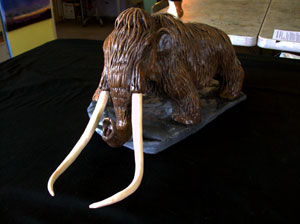
I fired him to Cone 06 which I should have taken him to Cone 6 but this is the first big sculpting project I've done in a while and I did not want him to explode in the kiln. When he came out, there were some stress fractures on the base so the low fire was a good plan and also left the clay porous enough for paint.
As far as paint, I used acrylics over a black base and finished it with a spray matte finish. The finish came out a bit shiny but in the right light it looks good.
I'm not really sure why I went with painting but I got started at Peach Festival just to see what it would look like and before I knew it, I was done and happy.
Working on wolves next but as usual I have to find the time.
Thursday, February 04, 2010
Tortilla Warmer 3.0


This version of the tortilla warmer turned out pretty close to perfect. It's almost 10 inches across which is the size needed for the fajita style tortillas.
Low,wide forms are a challenge for me especially low, wide lidded forms. But I have a few more of these to make now that I have the process down.
I'm also progressing on the pylon project using slab techniques. Had a bit of a breakthrough in that area around mid-January.
Off to a great start, pottery-wise this year. Gotta keep up the momentum.
Monday, December 14, 2009
Bus Stops and Poetry
I was on a bus coming from D.C. on my way back to Texas which is a god-awful trip to take on a bus. Its amazing how a hundred miles can feel like a thousand on one of those things. Several dozen travel weary people angry that they couldn't afford a plane ticket do not make good company. But around Knoxville, the company changed and I found the seat next to me occupied by a dark haired girl with long bangs, a blue jean jacket and a bright smile.
I'm not very outgoing in situations like that. I normally have a long book to read and I ignore everyone. But this one was not going to be ignored. The questions started with "Whatcha reading?" and "What's it about?" and "So you like Stephen King?" and continued until I closed the book and looked at her.
"Your not going to let me read, are you?"
Her dark eyes sparkled beneath those silken bangs. "Nope," she said.
I put the book in my bag and she launched into conversations that ranged from alien abduction to some pretty deep philosophy to favorite movies and music and back again.
Amazing how the right company can make a thousand miles seem like a hundred.
Early in the morning, the conversation waned and she snuggled against my arm, a little into my shoulder.
"Don't take this personally but I'm going to sleep on you," she said and dozed off.
Her hair smelled nice.
Hours later we pulled into the station where we would part ways. She was heading north, to Chicago I think. I was heading south. Her bus left in a hour, mine a little after that.
We pooled our money and bought a world class breakfast of cheap coffee, two bags of chips and a big candy bar. We spread it out on napkins and feasted, finishing one or two of the conversations from the night before. All done, we took turns watching each others stuff while we cleaned up in the bathrooms.
Suddenly, it was getting close to time and suddenly she seemed nervous.
"I want to ask for a phone number," she said finally. "but that's just leading to something that wouldn't work out,"
I shrugged and almost protested. But she just kinda smiled and shook her head. I realized then that there was more to her story than she was telling me.
"Let's just save this for a good memory and leave it at that," she said.
I nodded and looked to the ground, still fighting the urge to argue. But complication lurked like a demon in the shadows of too many miles.
She brightened and gave a little hop towards me. "But I want a hug," she said and spread her arms almost sheepishly.
I opened my arms and she stepped into me and squeezed tight.
And then the music started. Over the speaker system of the bus terminal. Eta James hit that note and she melted in my arms.
"Oh my God," she whispered against my cheek. "I love this song."
She didn't let me go. Not that I wanted her to. The music washed over us and we began to move. Just a little. It wasn't so much dancing as an excuse to hold each other tight. But her hand found mine and I pulled her in at the small of her back and it was nice. Natural. Comfortable.
Her temple was against my unshaven chin and she nuzzled against it.
"I didn't shave," I began but she shook her head.
"It's ok," she said. "I like it."
It's not a long song but it kept the rhythm of an eternal moment. Her hair still smelled like flowers and fresh rain. Her body fit so perfectly against mine, moved so perfectly against mine. Then she pulled back just a little and we were so close to a kiss it was painful.
"So if I let you kiss me" she said "will you love me forever?"
"I'll kiss you forever," I said. "But love..."
She nodded. "I know."
She held me tighter, tucking her head under my chin and we were lost to the song again for another eternal moment until it was slowly over, that last note like the first, haunting and perfect.
And as if on cue, they called her bus.
She held on a bit longer and then stepped away, hand lingering lightly on my chest as she turned without looking up. Then she grabbed her bag and was gone.
I stood there. Wondering what it was like in Chicago. Wondering what the rest of her story was.
And then, as if on cue, they called my bus.
I nodded and got my bag and turned.
A man was standing there. Thread bare suit, cheap fedora, six-string slung across his back.
"Poetry," he said with a smile and glistening eyes. He shook his head and walked away. "Just pure poetry."
Yeah.
I guess it was.
I'm not very outgoing in situations like that. I normally have a long book to read and I ignore everyone. But this one was not going to be ignored. The questions started with "Whatcha reading?" and "What's it about?" and "So you like Stephen King?" and continued until I closed the book and looked at her.
"Your not going to let me read, are you?"
Her dark eyes sparkled beneath those silken bangs. "Nope," she said.
I put the book in my bag and she launched into conversations that ranged from alien abduction to some pretty deep philosophy to favorite movies and music and back again.
Amazing how the right company can make a thousand miles seem like a hundred.
Early in the morning, the conversation waned and she snuggled against my arm, a little into my shoulder.
"Don't take this personally but I'm going to sleep on you," she said and dozed off.
Her hair smelled nice.
Hours later we pulled into the station where we would part ways. She was heading north, to Chicago I think. I was heading south. Her bus left in a hour, mine a little after that.
We pooled our money and bought a world class breakfast of cheap coffee, two bags of chips and a big candy bar. We spread it out on napkins and feasted, finishing one or two of the conversations from the night before. All done, we took turns watching each others stuff while we cleaned up in the bathrooms.
Suddenly, it was getting close to time and suddenly she seemed nervous.
"I want to ask for a phone number," she said finally. "but that's just leading to something that wouldn't work out,"
I shrugged and almost protested. But she just kinda smiled and shook her head. I realized then that there was more to her story than she was telling me.
"Let's just save this for a good memory and leave it at that," she said.
I nodded and looked to the ground, still fighting the urge to argue. But complication lurked like a demon in the shadows of too many miles.
She brightened and gave a little hop towards me. "But I want a hug," she said and spread her arms almost sheepishly.
I opened my arms and she stepped into me and squeezed tight.
And then the music started. Over the speaker system of the bus terminal. Eta James hit that note and she melted in my arms.
"Oh my God," she whispered against my cheek. "I love this song."
She didn't let me go. Not that I wanted her to. The music washed over us and we began to move. Just a little. It wasn't so much dancing as an excuse to hold each other tight. But her hand found mine and I pulled her in at the small of her back and it was nice. Natural. Comfortable.
Her temple was against my unshaven chin and she nuzzled against it.
"I didn't shave," I began but she shook her head.
"It's ok," she said. "I like it."
It's not a long song but it kept the rhythm of an eternal moment. Her hair still smelled like flowers and fresh rain. Her body fit so perfectly against mine, moved so perfectly against mine. Then she pulled back just a little and we were so close to a kiss it was painful.
"So if I let you kiss me" she said "will you love me forever?"
"I'll kiss you forever," I said. "But love..."
She nodded. "I know."
She held me tighter, tucking her head under my chin and we were lost to the song again for another eternal moment until it was slowly over, that last note like the first, haunting and perfect.
And as if on cue, they called her bus.
She held on a bit longer and then stepped away, hand lingering lightly on my chest as she turned without looking up. Then she grabbed her bag and was gone.
I stood there. Wondering what it was like in Chicago. Wondering what the rest of her story was.
And then, as if on cue, they called my bus.
I nodded and got my bag and turned.
A man was standing there. Thread bare suit, cheap fedora, six-string slung across his back.
"Poetry," he said with a smile and glistening eyes. He shook his head and walked away. "Just pure poetry."
Yeah.
I guess it was.
Monday, December 07, 2009
Final Pictures of the Finished Wheel


I have to say I'm extremely satisfied with how she finished out. It sits comfortably and spins extremely well. I had a chance to throw the first pot after she was delivered to her new home and I honestly could have thrown all night. I'm very, very happy with the design and can't wait to build the next one.
Subscribe to:
Posts (Atom)

 Posts
Posts


